Begin with your routine
Picture a normal session. You place a permitted jar under the lamp, choose a setting, stay nearby and switch it off when finished. Which part of that routine would you like to make easier? Automatic shutoff, a less bright light and accommodation for different jars are distinct needs.
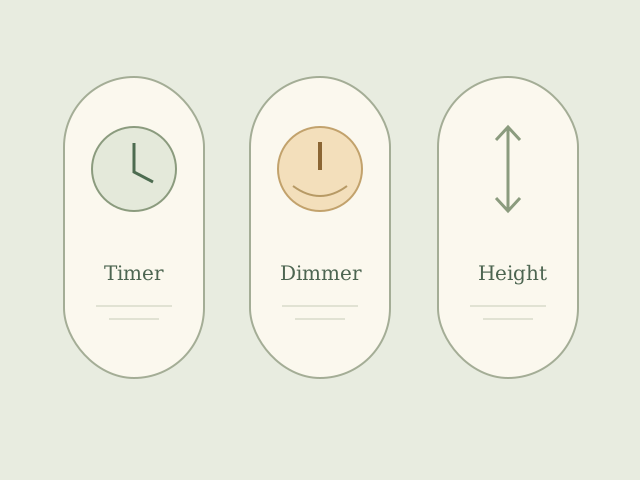
Buying all three controls may be reasonable, but it is not automatically better. A simple, well-documented device that fits one known candle can be more practical than a complicated model with unclear limits. The quality of the instructions matters alongside the number of buttons.
Timer: convenient shutoff, not supervision
A built-in timer can turn the lamp off after a selected duration. Verify which choices are available, how selection is indicated and whether the setting must be chosen every time the lamp is turned on. Do not infer those details from the word “timer” alone.
Some controls may remember a setting, while others may reset; check the exact model rather than assuming either behavior. Ask whether the countdown begins on activation or after a separate button press. A clear indicator makes it easier to know which mode you selected.
The timer does not sense whether a curtain moved, a jar cracked or a pet approached. It also does not establish a universally suitable session length. Choose a permitted operating routine, and turn the lamp off before leaving or sleeping. Do not bypass runtime limits by repeatedly restarting the timer.
Dimmer: light and heat may change together
When the warming bulb is also the light source, changing its output can affect both visible brightness and warming behavior. A lower approved setting may suit a reading corner but may change how the wax melts. There is no guaranteed identical fragrance performance at every brightness level.
Check whether the control is a dial, a slider or stepped buttons. Find out whether an actual off position exists and how the lowest permitted setting is described. A smooth dial is not necessarily more useful than clear steps; the easier choice depends on how you operate the lamp.
A dimmer is not necessarily temperature control
Do not interpret a brightness setting as a measured wax temperature. Unless the manufacturer documents a temperature-control system, assume the feature is simply the control described in its manual. Avoid inferring thermostatic protection, overheating prevention or a specific temperature from marketing language.
If a candle does not warm as expected, confirm fit and the approved bulb before changing settings. Do not exceed an operating limit to compensate for a weak scent. Our troubleshooting guide explains where ordinary checks should stop.
Adjustable height: useful within a documented range
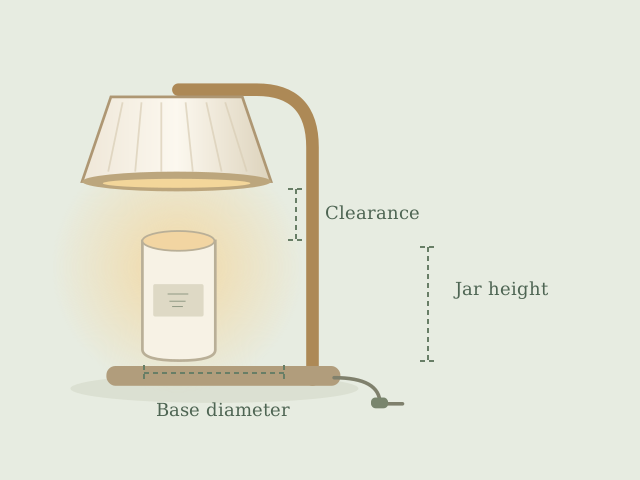
Height adjustment can help accommodate different jars or wax surface levels, but the permitted operating gap still controls the setup. Find the usable adjustment range, the manufacturer's clearance requirements and the method that holds the selected position.
Inspect the design for practical access. Can you adjust it without placing a hand near a hot part? Does the manual require switching off, unplugging and cooling first? Follow that procedure rather than copying a product demonstration that may omit important steps.
At any approved height, the shade and bulb must remain clear of the candle. The jar should sit fully on the intended platform. Do not prop up a short candle, alter the stem or loosen a mechanism beyond its limit. Our measurement guide distinguishes overall height from usable clearance.
Compare the controls together
| Your situation | Feature to consider | Limitation to check |
|---|---|---|
| Different jar heights | Adjustable height | Range and required operating gap |
| Bright light feels distracting | Dimmer | Warming behavior at approved lower settings |
| You want a selected shutoff time | Timer | Available durations and reset behavior |
| Controls are hard to reach | Accessible button or dial layout | Cord position, label visibility and ease of use |
This is a needs comparison, not a ranking of product performance. If two models both meet your practical requirements, you can then compare finish, footprint and cost. Features do not compensate for missing safety instructions or unverified compatibility.
Bulbs, switches and replacements matter too
Confirm the exact replacement bulb specification, including the details the manual requires beyond wattage. Check whether replacements are available from a reliable source and whether the lamp includes a spare. Do not assume a generic LED replacement will provide the intended warming function.
Look at where the switch and timer sit. An inline cord control can be easy to use on an open table but awkward behind furniture. Touch controls may have small labels. Think about whether someone using the lamp can confidently identify off, timing and brightness without reaching across the heated area.
Be cautious with external accessories
An external timer or smart plug is not automatically equivalent to a built-in feature. The appliance's instructions must permit that use, and its power-restoration behavior matters. Do not set up automatic remote activation of a warmer based only on a general accessory claim.
Similarly, adding an external dimmer or substituting another bulb changes the equipment combination. Use only accessories and replacements approved for the exact lamp. If the manual is silent, ask the maker rather than treating compatibility as implied.
Questions to settle before ordering
- How does each control work, and what do its indicators mean?
- Which settings are available and permitted for normal use?
- Does the timer need resetting after every session?
- What clearance is required at each allowed height?
- Which bulb and accessories are approved?
- Can I find the manual before buying?
Choose controls that make a careful routine easier. Clear operation, confirmed fit and replaceable parts usually tell you more about everyday usefulness than an impressive feature count.