Start with a stopping rule
If you notice smoke, sparks, an electrical burning smell, cracked glass, a damaged cord or a broken socket, stop using the lamp. Disconnect power only if it is safe to do so. Do not keep switching it on to see whether the problem repeats.
This guide covers user-level checks described in the manual, not electrical diagnosis or repair. Do not open the base, bypass a timer, bridge contacts, probe a socket or handle internal wiring. Contact the maker or a qualified service provider when ordinary checks do not resolve the issue.
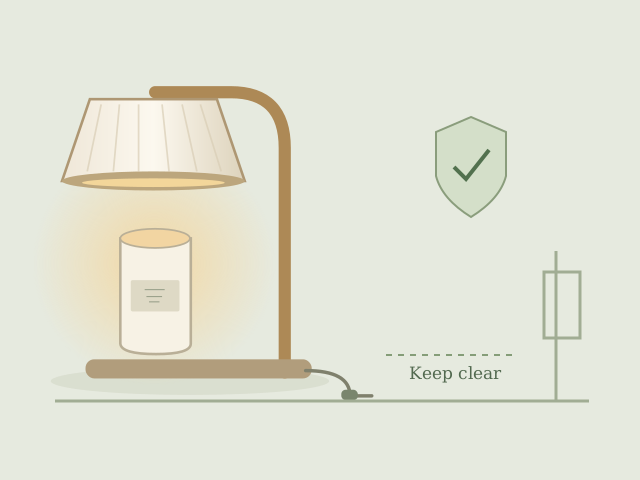
For every inspection involving the bulb, jar, fittings or cleaning, switch off, disconnect power as instructed and wait for cooling. Follow the exact model's procedure. Do not reach under a hot shade to make an adjustment.
Problem: the bulb does not light
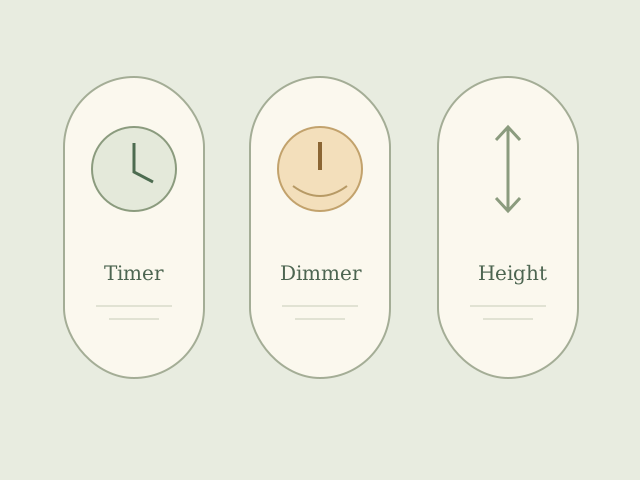
First review the control sequence in the manual. A timer may require a separate selection, and a dimmer may be at off. Do not assume that a control label means the same thing across different lamps. Check whether the plug is properly connected to an appropriate outlet.
If the cord, plug or outlet shows damage or unusual behavior, stop. If the setup is intact, check whether the manual permits you to replace the bulb. Use the documented replacement, after the appliance is disconnected and cool. A higher wattage or a different bulb type is not a troubleshooting shortcut.
If an approved replacement still does not work, or replacement requires force, seek support. Do not attempt to distinguish a wiring fault from a switch fault yourself. Keep the lamp unplugged until the maker has advised the next step.
Problem: there is light but little melting
Confirm that the installed bulb is the one specified for the lamp. Light output does not establish warming suitability. Then check jar compatibility, the permitted operating gap and the selected setting. A candle that physically enters the opening may still be outside the supported arrangement.
Review the maker's expected operation for your model, while recognizing that candle size and wax characteristics can change the experience. Do not assume every setup must form a melt pool in a fixed number of minutes. There is no universal time benchmark in this guide.
Never speed up melting by adding foil around the candle, covering the shade, fitting a stronger bulb or raising the jar on a makeshift support. If the approved setup does not work, document it for support rather than altering the heating geometry.
Problem: the fragrance seems weak
Check whether this is a new candle or one that has been warmed repeatedly. Fragrance can diminish even with wax remaining. Room conditions and personal perception can also affect what you notice. Weak scent alone does not establish that the appliance has a fault.
Use the approved bulb, fit and controls, then decide whether the scent is simply less noticeable than you prefer. Do not increase heat outside the manufacturer's range or run repeated extended sessions. Comparing two different candles does not isolate lamp performance.
If the maker recommends removing a depleted top layer of wax, obtain a clear procedure and follow it only if you can do so safely. This article does not recommend improvising hot-wax handling. Do not put wax into a drain. See candle care basics for routine care.
Problem: the candle does not fit securely
Check actual jar height and widest diameter against the documented candle capacity. Also inspect the flat platform and clearance around the stem. A jar may be wide enough to overhang the usable support while looking acceptable from above.
If the lamp has height adjustment, use only the approved range and locking procedure. Do not bend the stem or remove parts. A compatibility problem is usually resolved by a permitted candle or a different lamp, not a structural modification. Our measurement worksheet helps identify which dimension is limiting.
Problem: controls seem inconsistent
Read how the timer resets and whether the dimmer remembers a setting. Some apparent inconsistencies may be the intended control behavior, but this must be established from documentation rather than guessed. Make a note of the sequence you used.
If the switch is loose, unreliable or visibly damaged, stop use. If the lamp is connected through an accessory, check whether that accessory is permitted; do not add another device to work around a malfunction. Unexpected activation or repeated shutdown deserves manufacturer advice.
Match the symptom to a next step
| Symptom | User-level check | Stop and seek help when |
|---|---|---|
| Light, little warming | Approved bulb, setting and clearance | The documented setup still does not work |
| Weak scent | Candle history and approved setup | Unusual heat, smell or damage accompanies it |
| Poor fit | Jar dimensions and support area | The jar cannot sit securely within specifications |
| Timer confusion | Manual's selection and reset behavior | Controls malfunction or operate unpredictably |
Prepare a useful support request
Record the model identifier, the bulb specification, candle dimensions, control settings and a concise symptom description. Note when the problem began and whether anything changed. Include photographs of labels or the cool setup if the support channel allows them.
Do not publish your purchase details or personal information in a public review simply to obtain help. Use the manufacturer's actual support channel. Warm Home Notes is an information website and cannot diagnose or authorize repairs to your device.
Keep troubleshooting bounded. Once the ordinary documented checks are complete, the next step is support or replacement—not another improvised experiment.